
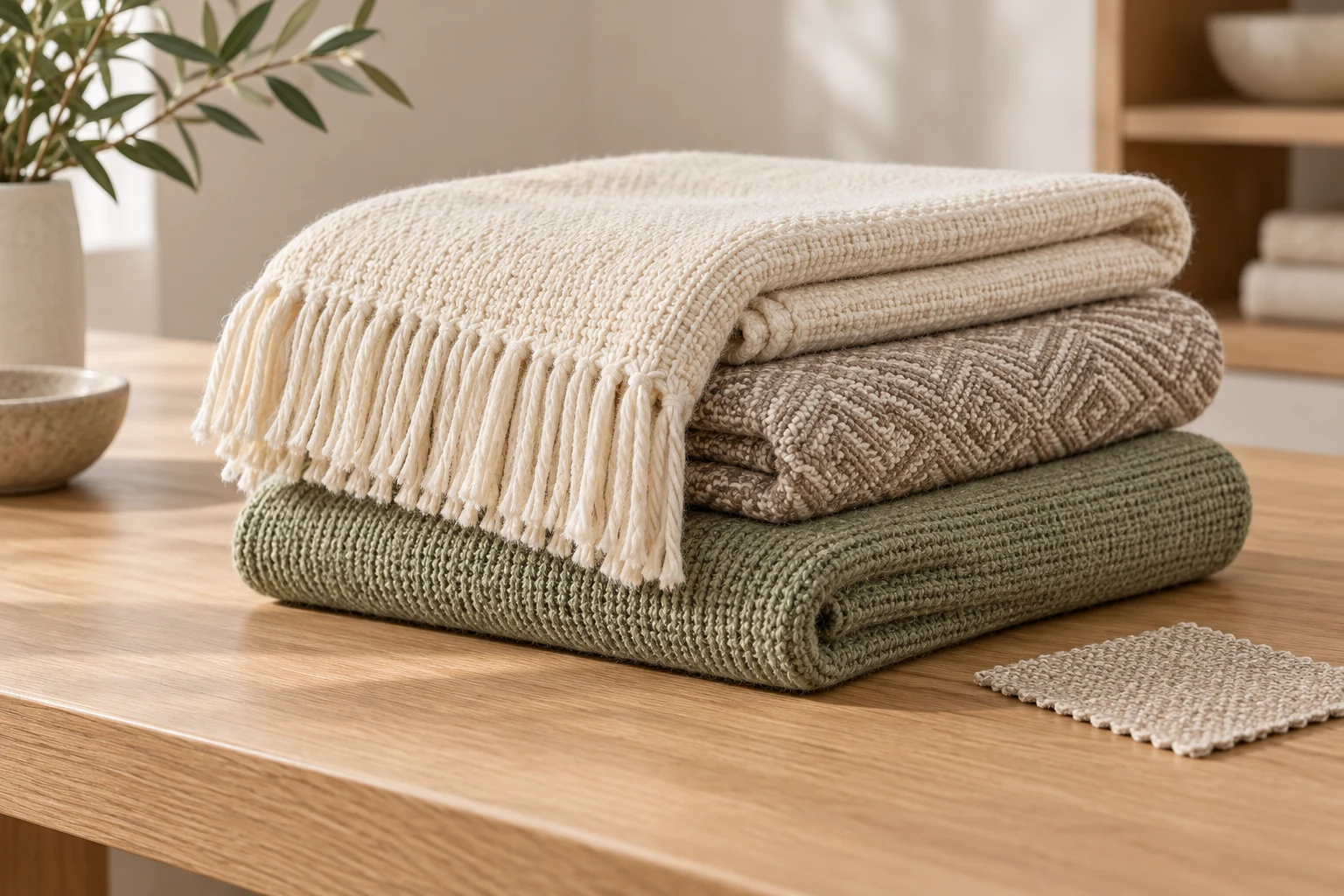
To source wholesale throw blankets, define the retail use, construction, finished dimensions and weight basis, then confirm quantities, sample checks and packaging with the supplier. Compare physical samples before committing to a bulk order. A throw can look substantial in a photograph yet feel lighter, firmer or more open than a buyer expects. Ordering samples without a shared brief leaves the supplier guessing which qualities matter. Start by defining the product’s use and the decisions the sample must help you make.
For retailers, importers and private-label brands, the aim is to compare like-for-like options while leaving room to evaluate hand feel and drape in person.
Start with intended use and collection role
Explain whether the item is a decorative sofa throw, a bed blanket or another product with different handling needs. Describe the target appearance, intended customer and retail presentation. State any specific use requirements that need separate evidence rather than assuming a familiar fabric name establishes performance.
Tell the supplier which features are fixed and which are open to recommendation. A color palette might be fixed while the weave, edge finish or yarn choice remains under discussion. Ask for alternatives to be identified clearly in the sample record.
Compare woven, knitted and surface-finished throws
Describe construction and finish separately from fiber content. A woven jacquard, a knit and a brushed surface can create different visual and tactile results. Ask which options suit your brief and evaluate the actual sample; construction labels alone do not establish warmth, pilling resistance or care performance.
Plan the assortment around the products and colors you intend to retail. If cushions and throws will be sold together, compare physical color and texture references under the same review conditions. Our cushion cover buying guide covers the coordinating cover decisions.
Define body size and fringe separately
Record width, body length, fringe length and whether the advertised dimensions include the fringe. Include a simple measurement sketch if the design has borders or decorative ends. Agree the sample measurement method and the order’s dimensional tolerance.
Our AP260971 jacquard fringe throw is listed at 130 × 150 cm (51.2 × 59.1 in), with 5 cm fringe trim and an 80% polyester, 20% viscose composition. These are useful starting details for an inquiry; confirm the size measurement basis and current specification before ordering.
Keep fabric weight and piece weight distinct
GSM means grams per square meter: the mass of a given area of fabric. Finished-piece weight is the mass of the complete item, including its edge treatments and trims. If a quotation says only “weight,” ask which of these it means.
GSM does not describe the whole product. Two fabrics with the same GSM can differ in thickness, structure and drape. When comparing samples, record construction, composition and dimensions alongside weight. If piece weight is important for the program, agree what is included in that measurement and how it will be checked.
Review construction and hand feel in person
Ask for the fiber composition and whether the item is woven or knitted. Note any brushing, raised surface or decorative yarn effects that are important to the brief. Handle the full sample as well as the swatch: fold it, drape it over an edge and review both faces.
Use one agreed physical reference for words such as “soft” or “fluid.” If several people approve the collection, record their decision against the same sample version. Photos can document a review, but they cannot replace touching the material.
Agree care and performance checks before approval
Confirm proposed care instructions with the supplier using the actual fiber blend, finish and construction. Identify the relevant checks for your program, such as dimensional change after care, color change, surface pilling or fringe condition.
Agree the test method, conditions and acceptance criteria where formal testing is needed. A casual wash trial can inform a design decision, but it is not interchangeable with a specified laboratory test. Do not assume results from another fabric apply to your sample.
Use a comparison sheet for every sample
- Identity: supplier reference, sample version, color and date received.
- Size: body width and length, fringe length and measurement basis.
- Material: composition, construction, finish and agreed reference swatch.
- Weight: GSM or piece weight, clearly labeled with units.
- Review: hand feel, drape, edge finish and care or test findings.
- Decision: approved, changes required or rejected, with the reason recorded.
Questions about wholesale throw blanket orders
Is a heavier throw blanket always better?
No. Weight is one specification, not an overall quality grade. The appropriate product depends on use, construction, feel, size and care needs. Record whether the quoted weight is GSM or finished-piece grams, then compare the full samples against your retail brief.
What MOQ should I expect for custom throws?
Ask for an item-specific minimum based on yarn or fabric, design, color, dimensions and packaging. Separate stock options from made-to-order development. Do not assume the minimum for an existing item applies to a new color or a different construction.
Does the listed throw size include the fringe?
Confirm it explicitly. Record body length, width and fringe length separately, with a measurement sketch where useful. Two suppliers can use the same nominal size while measuring different parts of the item, making a price or weight comparison misleading.
What packaging details should go into the quotation?
Include the folding method, paper band or other retail pack, labels, unit count and carton assortment. Ask the supplier to identify inclusions and exclusions. Custom branding belongs in the same order brief; our private-label and OEM/ODM guide explains the development choices.
Use our throws and blankets collection to identify starting points, or discuss custom colors and construction. Send enjoyhomeware your sampling brief with the comparisons you need to make.