
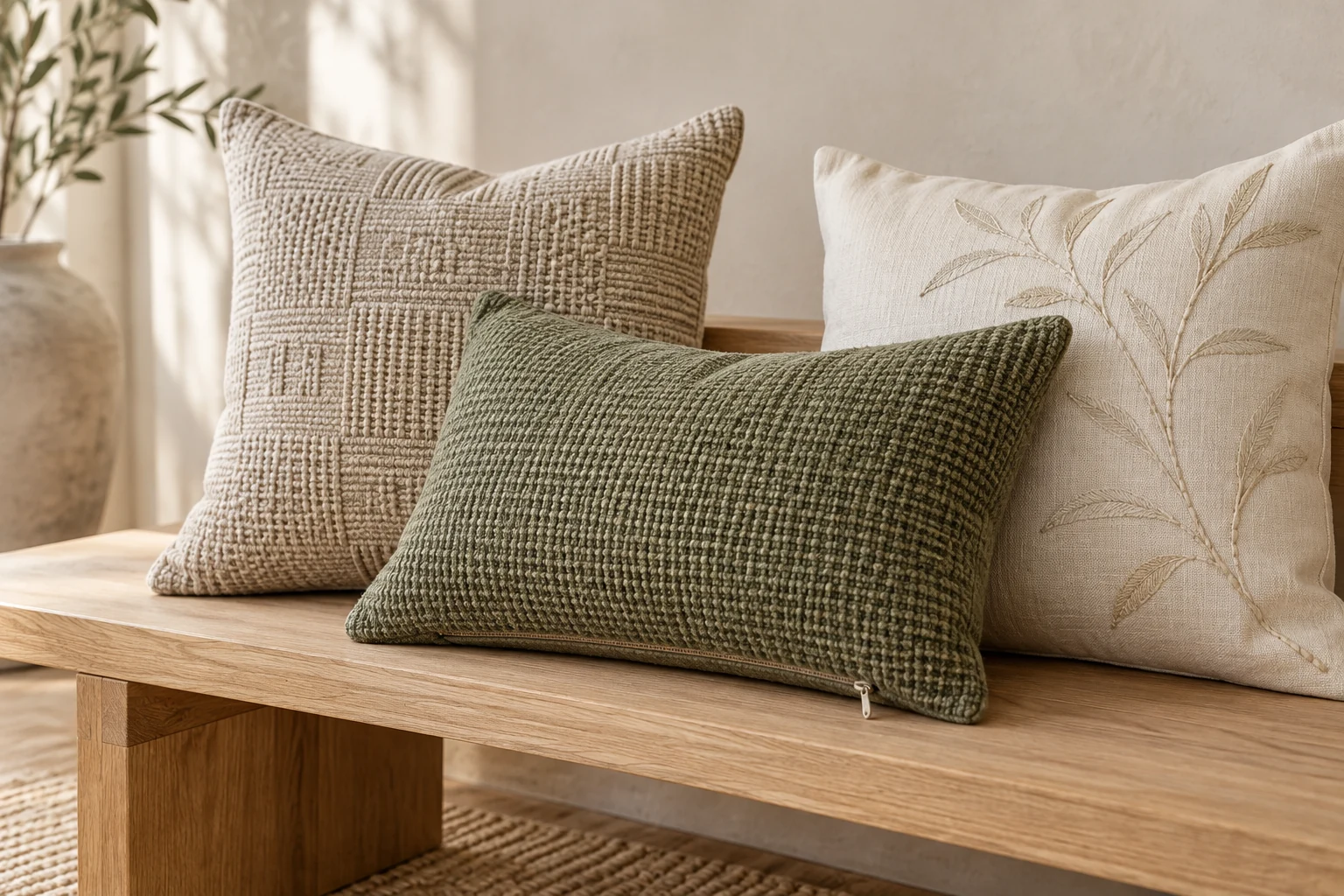
To buy wholesale cushion covers, first choose a sourcing route, define the fabric and finished size, confirm whether inserts are included, then compare samples and quotations against the same specification. A cushion collection can look coordinated in a mood board and still contain very different products. The front fabric may match the reference, while the reverse panel, zipper position or insert changes how the finished cushion feels and fits. A buying specification should make those differences visible before an order is placed.
Use this checklist when reviewing wholesale cushion covers, developing a private-label range or comparing samples from different suppliers.
Choose stock sourcing or a custom cushion program
Ask whether the quoted product is available from existing stock or requires production for your order. Stock sourcing and custom development involve different decisions about available colors, labels, packaging and replenishment. Do not assume a catalog listing means ready-to-ship inventory.
Decorative cushion covers are also called throw pillow covers in some markets. They are the outer covers used with decorative inserts, rather than bed pillowcases. Identify the intended product in the inquiry so sizes, closures and packaging are quoted on the right basis.
Compare fabric construction and front/back materials
Describe the intended color, pattern and texture, then identify how the design is made. A jacquard pattern is formed through weaving; embroidery adds decorative stitching to a base fabric; printing applies a design to a fabric surface. These terms describe techniques. They do not, by themselves, establish softness, durability or care requirements.
Request a physical swatch when the texture matters. Review the sample in the lighting used for your collection decisions, and keep an agreed reference for later comparisons. A screen image is useful for design discussion but should not be the sole color approval.
Specify both sides of the cover
Record the composition and construction of the front and reverse separately. Ask whether both sides use the same material and whether the price includes a lining or other internal layers. If a linen appearance is part of the design brief, confirm fiber content rather than treating the appearance as proof of linen content.
Our AP260102A textured wrinkle cushion cover provides a concrete example: its listing specifies a 100% polyester front and a reverse of 3% linen and 97% polyester. The two panels should therefore be recorded separately in a purchasing brief. Confirm current specifications when requesting a quotation.
Agree how the finished size will be measured
State the finished cover dimensions and the measurement points. Explain whether piping, flanges or other trims sit inside or outside the stated size. Agree whether the cover is measured flat and relaxed, and record the method with the approved sample.
AP260102A is listed at 30 × 50 cm (11.8 × 19.7 in). That identifies the nominal size; the acceptable production tolerance still needs to be agreed for the order. Avoid applying one tolerance to every fabric or construction.
Check the closure and actual insert together
Specify zipper or envelope closure, its position and the usable opening. Test insertion and removal using the insert you intend to sell. Check that corners fill as intended, seams lie comfortably and the closure operates without excessive force.
Confirm whether the price covers the shell alone or a complete cushion. If an insert is included, record its size, filling and weight separately. There is no single oversizing rule that gives every cover the same appearance: insert construction, filling and cover shape all affect the result.
Compare two construction options on the same basis
Suppose you are developing an oatmeal jacquard cushion collection. You could request one quotation with jacquard on both sides and another with a coordinated plain reverse. This is a hypothetical comparison, not a promise that either option will always cost less.
Keep size, order quantity, closure and packaging the same in both requests. Then compare quoted cost, feel, appearance and sample results. A reverse fabric that looks acceptable in a photograph may still change the drape, opacity or handling of the finished cover.
Make the sample review repeatable
- Match the approved front and back fabric references.
- Measure the finished cover using the agreed method.
- Check seam finish, trim attachment and zipper operation.
- Fit the intended insert and review the finished shape.
- Confirm care instructions against the actual materials and construction.
- Approve label position, folding and retail packaging.
Questions about buying wholesale cushion covers
What is the minimum order quantity for cushion covers?
Confirm MOQ for the exact fabric, design, color and size combination. Ask separately about custom labels or packaging. A total quantity across several SKUs is not the same order structure as that quantity in one design. Request an itemized quantity breakdown in the quotation.
Are cushion inserts included in a wholesale price?
They may or may not be. Ask for a cover-only price and, where relevant, a separate complete-cushion quotation. Record insert size, filling and weight alongside the cover specification. AP260102A’s listing offers both supply options; confirm which one your quoted price includes.
Which cushion fabric is best for my collection?
Start with the intended use, appearance, target price and care requirements. Compare actual fabric composition and construction on physical samples. A word such as jacquard, velvet or linen-look does not establish all performance characteristics, and there is no single best fabric for every collection.
Can I add my own label and packaging?
Brand labels, hangtags and packaging are within our published customization services. Confirm artwork, positions and pack-out for the selected item. Our OEM vs ODM guide explains how private labeling fits with a buyer-led or supplier-developed product.
Explore our cushion collection to select reference styles. For coordinated fabrics, sizes and branding, review our custom development services or send enjoyhomeware your cushion specification.